
Friday 2nd Nov 2018
I’m using this blog to outline my study and preparation for a project for my ADR and foley module, for this project I will need to recreate all audio from a 5-minute clip (excluding music). This includes all dialogue, foley and environmental sounds.
Today my classmates and I chose which film clips we would use. Knowing that there had to be a reasonable amount of dialogue to meet our criteria for ADR my group and I elected to use a scene from the film Gladiator. This is as the film is filled with strong, well-paced dialogue while also taking place in a variety of environments. The scene we’ve chosen features 3 environments, dialogue from 7 characters and a variety of sounds which will need to be replicated. Unfortunately, there were some issues which needed to be addressed with the rate of playback which prevented us from progressing any further this week. By the 9th I hope to have marked all of the audio queues in our ProTools project and to have studied some more of the functionality available in ProTools to improve my workflow when it comes to producing my final piece.
Friday 9th Nov 2018
Since my last entry my group and I have plotted all audio queues for our project and categorised them based on whether they’ll need to be recorded in the studio or with field recorders. This was mainly divided by whether the sounds were environmental or not. We also discussed how we intended on recreating some of the sounds we needed to capture, below are the notes I took during this session.
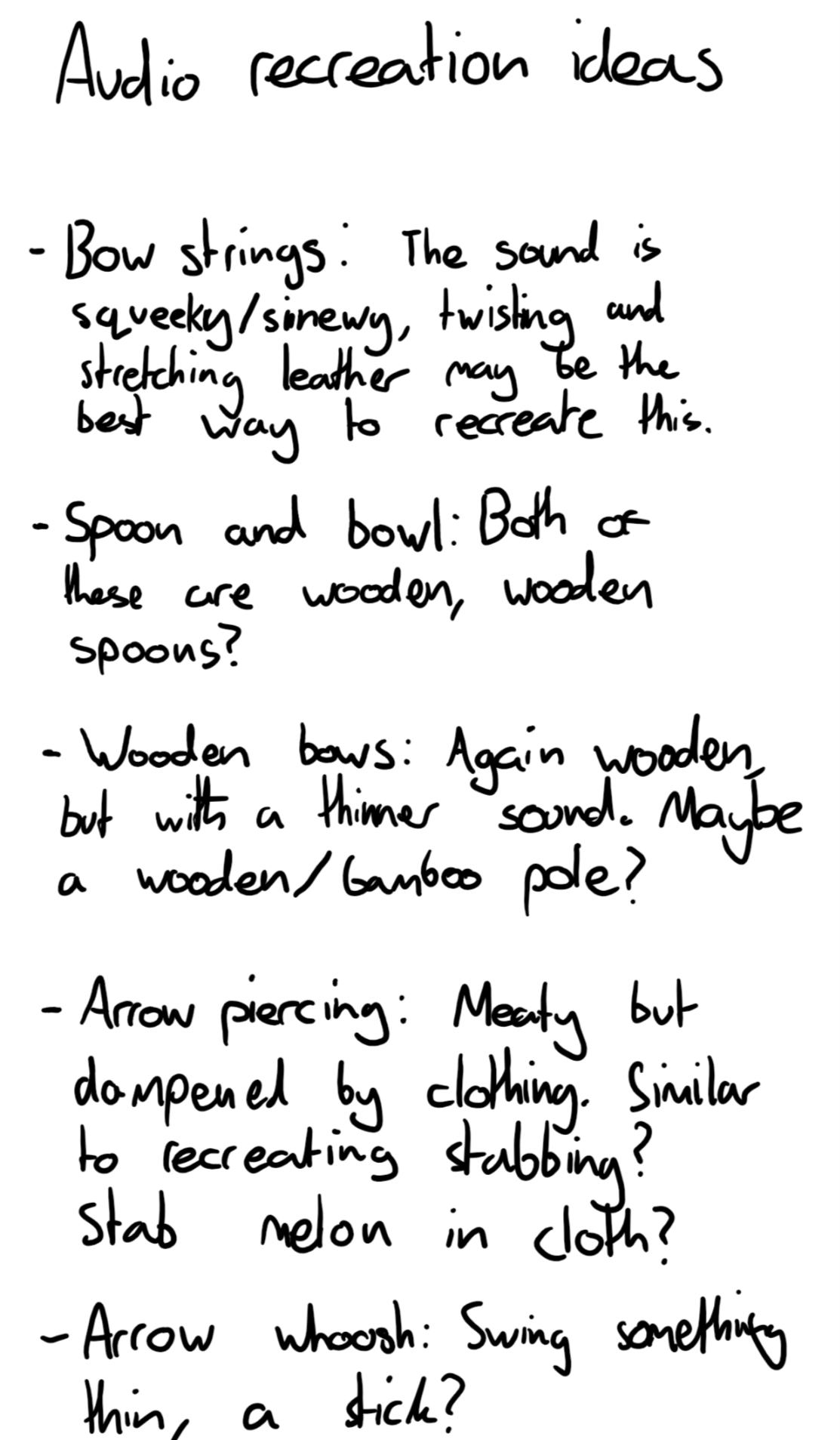
As shown here we intend upon recreating the audio as realistically and faithfully as is achievable within our limited timeframe. I personally also intend upon using a limited collection of audio processing (such as EQ and compression) in order to make the sounds more similar to those in the film. I’ve also been studying hotkeys available in ProTools since my last update which have proven useful in the audio plotting process.
By my next update (16th Nov) I hope to have begun the recording process and to be gathering some of the resources required to recreate some of the more complex audio.
Friday
16th Nov 2018
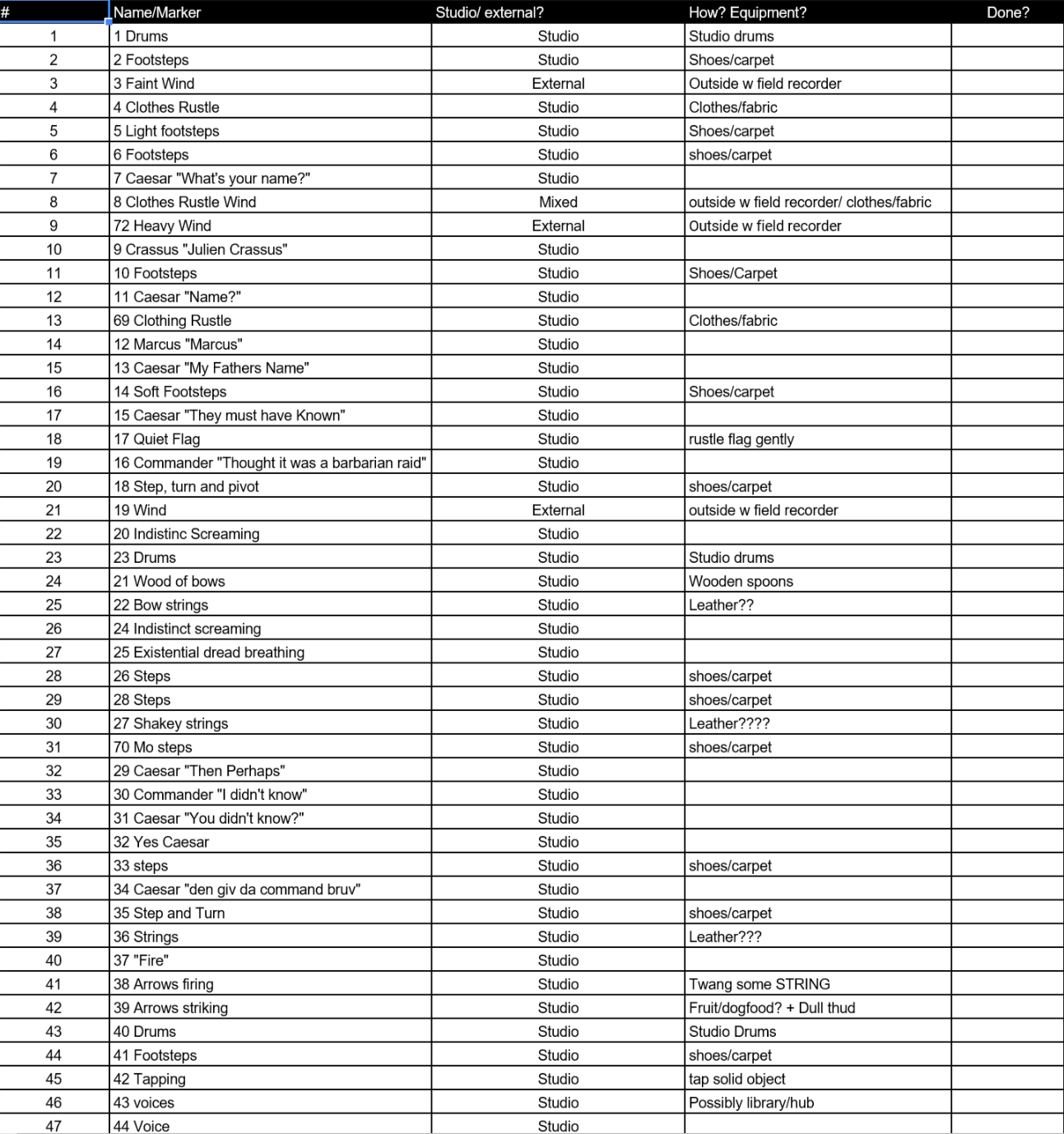
Since my last update my group and I have prepared more for the recording
process by creating a list of every audio queue, whether we’re recording it in
the studio or with the field recorder and how we intend upon recreating the
audio.
Friday 23rd Nov 2018
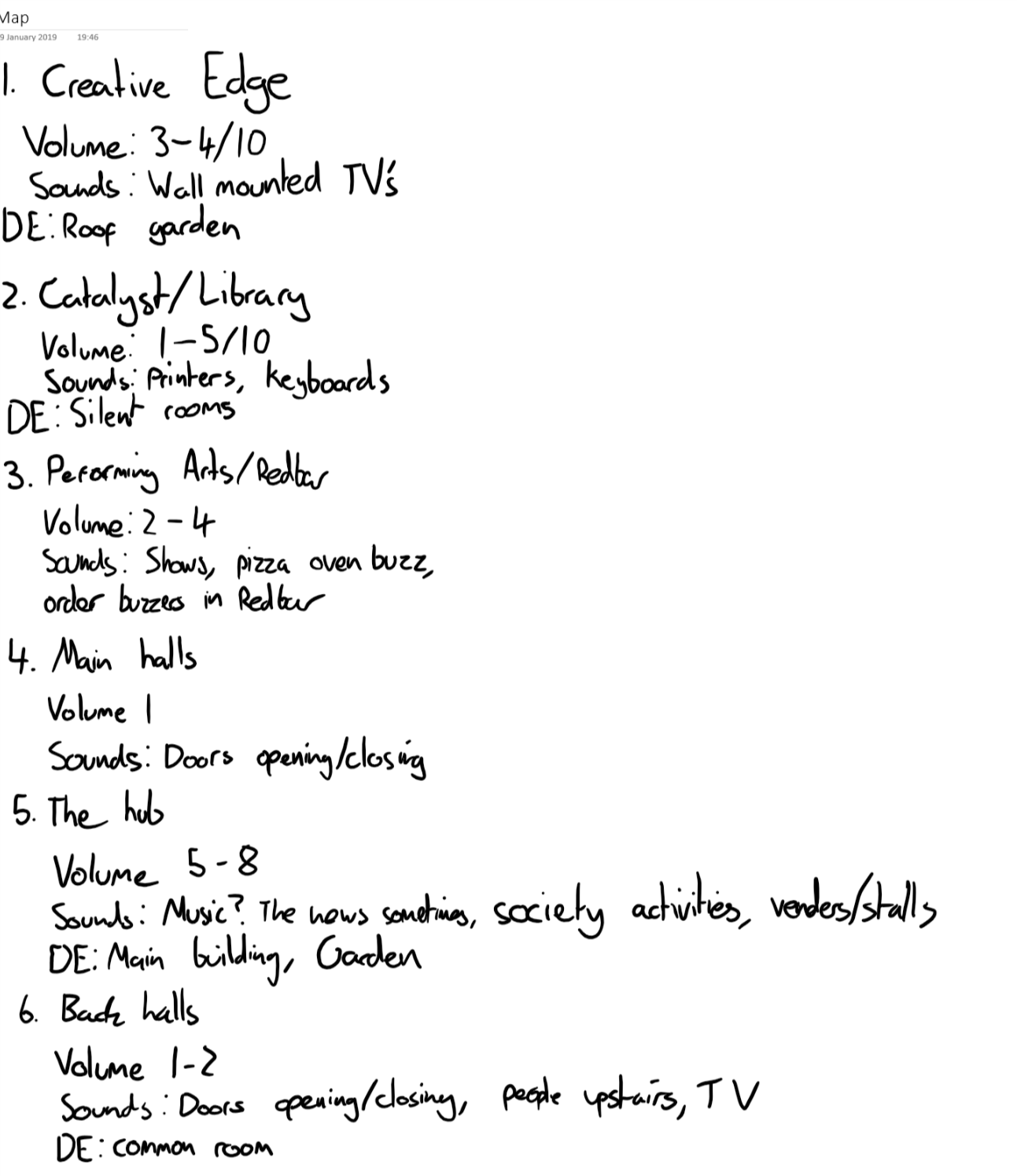
Since my last entry Connor (another member of my group) and I have been out and done field recording for our project in an array of environments from quiet libraries to noisy halls, while not all of them will be used in the scene we hope that we’ve captured a span of environments large enough to cover all bases for the scene we’re working with. While recording we did focus on noise levels and realistic usability. We made sure our environments were always a similar volume to an environment from the scene that we had in mind, we also made sure to avoid any unsuitable recording environments. We got a map off the Edge Hill website and used it to mark where we could record, their likely noise level and any interfering sounds we could think of.
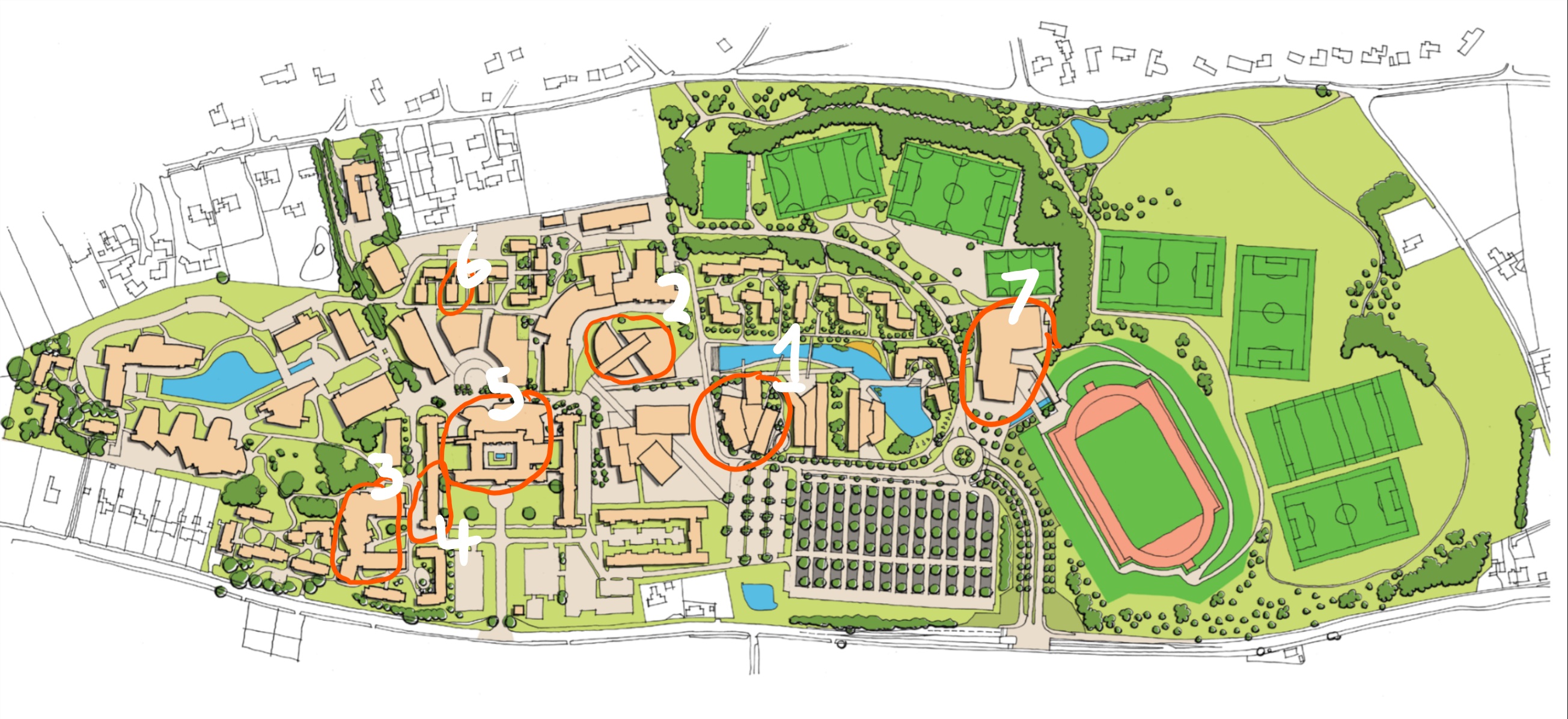
(Map available at https://www.edgehill.ac.uk/about/campus-developments/future-developments/)
(When noting sounds which may interfere with our recordings we elected not to note sounds which could be present anywhere outside of the relative ambience such as people being excessively loud.)
While we had marked a 7th location on the map, the Sports Centre, we elected not to use it as it’s primarily a leisure facility and we didn’t want to disturb people.
In the end our best recordings were taken at the roof garden of location 1, the silent rooms in location 2 and in location 6.
By my next entry I hope to have applied these sounds to the clip and to be trying to find potential voice actors. Before that I need to consider the characters voices in the original clip and consider vocal ranges. My reasoning for this is for the sake of the voices matching the characters.
Wednesday 28th Nov 2018
I’m writing this entry as an update on the
progress of finding voice actors. Below is a screenshot of the spreadsheet for
voice actors and their respective characters.
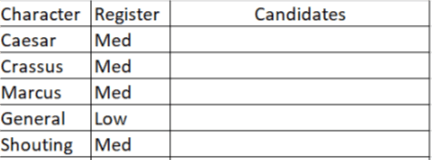
After I spoke with my group, we elected that voice actors would be a second thought once we had the rest of the scene recorded, as this project is more of a test of our technical skill than ability to recruit voice actors. Having said this, it’s still useful to have this table as a simple plotting device for when we get around to the voice acting.
Friday 30th Nov 2018
Since my last entry Connor, Nikita and I have recorded in
the studio, we mostly captured footsteps and clothing, to provide a touch of
realism before continuing to work on the clip. We’ve also recorded a lot of the
drumming in the clip we’ve selected. While this is only a small dent on the
list of overall sounds we have yet to record, it does make an impact in the
overall clip.
This week I’ve also been researching sound design more, perusing the sound
effects bible in my spare time. So far I’ve begun to understand the relevance
of balancing Foley, ADR and music to maximum effect. Simply distinguishing
between hard sound effects and foley sound effects has been a massive
assistance in the recording of sound effects, understanding that for Foley it
is the performance in the recording process that sells the final product (Viers,
2008).
Friday 14th
December 2018
Since my last entry I’ve applied the environmental sounds that Connor and
myself recorded, while they don’t suit every environment in the scene we’ve
chosen they are widely useable throughout, I intend upon finalising these
decisions and then going on another recording session to cover any
environmental sounds that haven’t already been addressed.
I’ve also been reading on sound design in 3D environments in preparation for
the project, most notably “Sound Design to Enhance Presence in Photorealistic
Vitrual Reality” a brief write up on a section of the International Conference
on Auditory Display, Sydney, Australia, July 6-9, 2004. The section focuses
namely on virtual reality environments, however a lot of the auditory methods
discussed have their origins in film sound. Some interesting techniques I
intend upon utilising that I drew from this excerpt include; using stereo
panning to track noise origin movement, exaggeration and emphasis of sound
effects to capture viewer attention and utilising low frequency sounds to
immerse the viewer in the world and give it tangible presence (Serafin and
Serafin, 2004).
I believe this link between low frequency audio usage and immersion stems from
the physical presence that loud bass-oriented audio can present in terms of
vibrations. Having a physical reaction occur in the viewer through audio, at
the same time that an event happens on screen is invaluable in selling the
believability of the audio we’re recording in my opinion.
However with all of this in mind, it’s also necessary for the audio to hold up
in mono, and on a variety of speakers. These two contrasts of playback environment,
in my mind and with the knowledge that I have of sound design, seem to create a
form of balancing act, one that’s present in the mixing and mastering of music.
Hopefully my abilities in that field will transfer well into sound design for
film.
By my next entry I hope to have recorded ambient environments for the rest of
the clip using the field recording kit and also to have further researched the
field of sound design for movies.
Friday 28th
December 2018
Since my last entry I’ve been attempting to make
arrangements for voice actors to come in and record in the New Year however it
would appear the majority of students in my class have had a similar idea and
as a result of this the majority of acting students I’m able to get in contact
with are already busy throughout the new year. At this point I’m considering
one of two options, either publicly advertising the position throughout
university campus in the form of posters and fliers (although I assume this
would require getting permission from the department or university). Or,
recording the dialogue in-house using the voices of myself and my friends.
Although this second method offers the disadvantage of less than professional
voice acting, it does offer a lot more flexibility in the recording process, in
theory this flexibility would allow us to capture as many takes as needed to
get a professional result.
I’ve also attempted to borrow the field recorder for the sake of capturing the
ambient environments I spoke about in my last entry, however this was to no
avail due to being out of term-time. Luckily a friend of mine had a high
quality lavalier microphone that I was able to borrow and use to record with my
laptop.
By my next entry I intend to have started the recording process for the dialogue
within the clip using my own personal set-up. Obviously, this isn’t ideal
compared to the facilities provided by the university however the deadline for
the work is closing in and at this stage I’d like to be working on it in any
capacity that I can. If by the time the work’s complete we have an opportunity
to re-record the dialogue I’d be more than happy to discard the recordings,
I’ll be making over the coming week.
Friday 4th
January 2019
Since my last entry I’ve travelled back to my home studio
and recorded some of the dialogue for the chosen clip using my own voice and
the voices of some of my friends. In my last entry I spoke about how ideal this
process would be, stating how audio quality and the quality of the acting would
suffer. While this is somewhat true for the quality of the acting within the
clip, the overall sound quality is very usable. The sound profile of the voices
is well-rounded and warm, and while there are technical issues with some of the
audio (plosives and sibilance related) the entire process has been successful
and would provide a good backup, should we not get the chance to re-record
before the deadline.
However, this could be indicative of a bigger problem. Reading through multiple
informational sources on sound design in movies paints one overarching theme,
the practise is a matter of taste and while there are certain standards to be
met, for the most part there is no definitive “right” or “wrong”. Following
this train of thought, how can I ascertain that the only reason that this audio
sounds fine to me isn’t because I have terrible taste? With little experience
in the field and having never been educated on it, unfortunately I cannot
ascertain this.
By my next entry I intend upon having pieced together as much of the audio as
possible and showing it to people, in multiple environments and through various
sound systems (phones, televisions, studio monitors and headphones) to get a
general consensus on the overall quality of both the recordings and the acting.
Friday 11th
January 2019
Since my last entry I’ve shown the clip to multiple
gatherings of people and spoken to them after about any improvements they
thought could be made. A few noted the voice acting, stating not that it seemed
out of sync but that it wasn’t a convincing portrayal of the character. None
mentioned audio quality and it seemed to hold up in a variety of situations to
the average listener.
With the deadline closing in next week I don’t think there’ll be a chance to
re-record the dialogue in it’s entirety, however we can re-record any of the
characters which are most problematic acting wise.
An immediate problem being faced at the moment is the deadline, unfortunately
we’ve not completed our list of audio required for the clip yet and are still
missing multiple hard sound effects and foley sound effects. As a result of
this Connor and I intend upon getting studio time next week to finish the
recording. At this moment the situation is disheartening but I believe it can
still be done, one of the issues I believe that will make itself most apparent
in the final stretch will be managing to meet the technical specification in
the amount of time we have to do so. However this is something which I could
stay up all night doing if need be and really the nature of the project demands
that this be left until last anyway.
By my next entry I hope to have read more on sound design to help prepare for
our final recording session and to get the most out of it.
Tuesday 15th
January 2019
Today Connor and I went onto campus and booked studio time
for Wednesday the 16th (tomorrow) for a final recording session
before the work is due. I’ve been reading The Sound Effects Bible front to back
over the weekend in preparation for this and believe I have the majority of the
ideas presented in the book retained in my mind.
While I feel confident about the level of preparation I’ve done for this
project, I’m less confident in my time management skills and it’s shown throughout
this journal. This, combined with a lack of communication up until this final
week between myself and my group, has ultimately led to a rush to get work done
before the deadline. While this hasn’t been great for overall stress and morale
it has seen a massive increase in productivity from all members within our
group.
Provided that Connor and I can get all the recording done that we need to
tomorrow, then throughout tomorrow evening and Thursday evening I can work on
my own individual mix of the project to ensure that it meets technical
specification. I am however worried about my fellow group members and am afraid
they may not have the time to work on this piece before it’s due in as I do.
By my next entry I’ll have been through the final recording process with Connor
and will be preparing for final work on my mix of the clip.
Wednesday 16th
January 2019
Today Connor and I went to the studio and recorded the final sounds we required
for recreating the scene. Over the next two evenings I’ll be working on the
piece for submission on the 18th.
By my next entry I hope to have finished the process and be ready to submit my
work.
Friday 17th
January 2019
Since my last entry Connor and I added in some more sounds which
he’d recorded externally in his studio for a further amount of detail in the
piece to hopefully aid the immersion. In the evening we rendered the Foley and
Sound Effects to their own stem and the ADR to its own stem ready for our final
studio session this morning.
This morning Connor, Nikita and I went into the studios to normalise the
overall volume level of our piece. Our piece had to match the European
standards stipulated by European Broadcasting Union R128 standard, to measure
this we used Izotope’s Insight. We made sure our audio levels remained tightly
within the range of 22.5 to 24 LUFS, (EBU R128 stipulates 23 LUFS with a 1 LUFS
headroom). Unfortunately after this we faced a prominent issue in that the
audio playback was drifting from the video. Not only during playback but also
during rendering, causing our audio and video to be wildly out of sync. To fix
this we took the files out of the studio and to a Macbook pro which we’d been
working on the file on without issue. We rendered it on there and it corrected
the error we’d ironically been labouring on for a few hours downstairs.
After this we submitted our work. Overall the process was difficult at times
but ultimately successful. Were I to do anything differently I’d have prepared
better for the process with more external reading and have started working on
the project earlier. Ultimately, I believe my biggest weakness was mediocre
time management, causing a sizeable amount of pressure in the last few days of
the process. It by no means compromised the work, but it did cause an amount of
stress within the group.
 James' Music Blog